Why we receive donations of Model Railway Items
BARM is a not-for-profit Club that has raised funding through donations of model railway equipment. These donations started as a result of the 2 years of COVID, at which time we could not hold shows or events to raise funds to support our Club.
We have continued to accept donations to provide a venue to the public to obtain good but older trains, track and buildings to start a model railway. This allows people of all ages to start in the hobby in an affordable way.
Donations are accepted with no preconditions.
Club Donations to Registered Charities
The membership of Barrie Allandale Railway Modellers, have provided donations to various registered charities serving the City of Barrie and the County of Simcoe. A list of the charities and photos is shown below. We continue to support these charities based on the amount raised by the sale of donated items.
1. Hospice Simcoe – 2024 donation of $3000
June 2024 – A big thanks to Richard, Dave, and Henk from Barrie Allendale Railway Modellers Association, for dropping by with a cheque for Hospice Simcoe. This not-for-profit Club has raised significant funding through donations of model railway equipment. As a result, they want to give back to the community and chose Hospice Simcoe as the recipient of $3,000. Thank you for the generous donation, we greatly appreciate our community support!

2. Hospice Simcoe – 2025 donation of $500
3. Busby Center – Donation consisting of 7 tents, 6 tarps and $800 cash totaling $2000

4. Women and Children’s Shelter of Barrie – $3000 in cash and in-kind donations as described below
We want to send a very big THANK YOU to Henk, Richard & Dave from Barrie Allandale Railway Modellers for stopping by with a wonderful donation of much needed outdoor tools, cleaning and shelter supplies. They also brought us 2 beautiful patio sets for our outreach house and even pout them together so they could be used to enjoy the warmer weather.
An addition $1,000 was donated that will go toward the purchase of produce and pantry food, baby items and addition shelter supplies. Community support like this helps us meet the diverse needs of our residents and the growing cost of groceries and supplies. Thank you!

5. COPE Service Dogs – $500

The following is provided with permission of the Victoria Model Railway Club. We thank them for allowing us to use it.
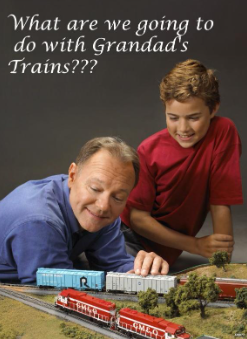
A Practical Guide to Dealing with Estates and Model Trains.
Presented by Victoria Model Railway Club
Here at Victoria Model Railway Club we are often approached by people with model trains in search of a new home. Often, they are family members, left with Grandad’s, or Dad’s, estate. Often, they have no idea of where to start, let alone how to go about things. Other times, the owners themselves have trains for which they have no further use, usually connected with downsizing or moving to an assisted living facility.
This leaflet should, we hope, offer some help.
Taking stock
The first task is to determine what you have.
- Is there a permanently installed display/diorama (more properly called a “Layout”) or is it a collection of locomotives, cars and accessories?
- Are the trains packed in original boxes or loose?
- What condition are the trains in? Items that are obviously broken will have substantially diminished value. Unassembled kits are also problematic as a buyer has no way of knowing if parts are missing.
- If available, what are some of the brand names of the items? While all trains may look the same to some, there are important distinctions among brands which greatly affect value. Some toy-like models may be worth a dollar or two each. Superior brands can command much more under ideal circumstances. Items made of brass (mostly locomotives, but occasionally other items), mostly dating from the 1950’s through 1980’s but with some later production, can be extremely valuable, depending on the item.
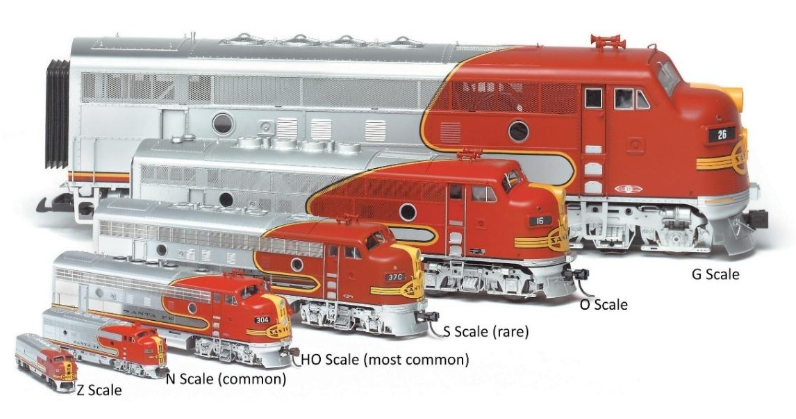
- What size (“scale”) are the items? Common scales are below:
- HO Scale is the most common. A diesel locomotive is typically 7 to 10 inches long. The space between the rails is 16.5 mm which is about 2/3rds of an inch.
- N scale is smaller than HO. A locomotive would typically be about 4 inches long.
- O scale is larger than HO. The rails are 1-1/4” apart and a locomotive would typically be about a foot long, or a little more. O scale is further divided into “3-rail” where there is a central third rail down the middle of the tracks, and “scale” which is usually more finely detailed and realistic looking than “3-rail” which is often (but not always) toy-like in appearance.
- G scale is very large, and is typically used outdoors (G stands for “Garden”).
- Victoria Model Railway Club members are sometimes available to visit your location (provided it is within reasonable travel distance of Victoria) to give general information to sellers on what the recommended course of action would be.
What do you want to do with these trains?
The easiest items to dispose of are locomotives and cars (“rolling stock”) packed in their original boxes with no damage. The hardest item to dispose of is a complete, intact layout.
If you do have an intact, complete layout, it may be possible to move it, particularly if it was built in sections. Otherwise, sadly, it may have to be dismantled which will likely render it useless in the process. Some items can be salvaged first – obviously all rolling stock should be removed, and scenic items such as buildings, automobiles, figures, and some electrical components should also be removed, preferably by someone familiar with the hobby. Generally, track is difficult to salvage and scenic features such as mountains are likely unsavable. The wooden frames or tablework on which a layout is built is also likely to be nothing but scrap wood; there is simply little or no market for such items. Generally, Victoria Model Railway Club members will not assist with the physical dismantling of a layout and harvesting of salvageable items. However, we can make specific suggestions as to how to proceed and it may be possible to make private arrangements with particular members to assist in the necessary work.
For the more marketable items, there are some choices.
- If you are comfortable with online selling, there are online venues that specialize in model trains. In particular there are several Canadian Facebook groups that have an active market. There are also generic markets such as eBay, Kijiji and Facebook Marketplace, but these tend to miss the main market. Always worth a try though. You do need to be able to test that locomotives actually work properly, take clear photographs, and deal with the complexities of packing and shipping to be able to maximize your chances of selling online.
- There are several train shows each year in southwestern British Columbia where one could rent a vendor’s table. You would need to pack your items for sale and then transport them, and yourself, to the location. Shows include Squamish (March), Nanaimo (April), Victoria/Sidney (September), and Chilliwack (October). The Vancouver show usually held in November has been cancelled for 2025.
- There are specialist dealers who will acquire collections. There are two kinds: traditional bricks-and-mortar shops who will take collections for resale, and on-line vendors, who will often travel to your location to view and remove items. Contact us for current information on such vendors. (Our club is financially independent of any vendors that we recommend; however, some vendors are members of the club.) Be aware, however, that dealers are in business to make a profit, and that the return to the original seller will be deeply discounted from retail to provide the dealer with a profit, cover his expenses and compensate him for the risk taken on in acquiring collections. Expect to see discounts of around 50-75% from estimated retail (so a $400 locomotive might return only $100 to you.)
- In certain circumstances, you might be happy enough to forego the trouble of selling and simply give items away. Victoria Model Railway Club is happy to receive donations of HO and N scale model railway items. Donations must be unconditional (so that we can make decisions about whether specific items should be sold, given away or scrapped). VMRC is a non-profit Society registered in British Columbia; however, we are not a Registered Charity and cannot give tax receipts for Canada Revenue Agency purposes. Victoria Model Railway Club does not purchase model railway items.
Some thoughts on value
We often hear from a family member that they knew that their loved one had spent thousands of dollars on their hobby, and that they expect to realize quite a lot of money from the sale of those items. Others will have seen prices on eBay and concluded that each model is worth at least a few hundred dollars or more. It is our sad task to provide reality checks – while some models do indeed command attractive prices, that is the exception rather than the rule. In thinking about value, please remember:
- First and foremost, the money spent on any hobby should be seen as the cost of entertainment for your loved one. That money was not an “investment”; it was for the consumption of something which gave your loved one pleasure at the time it was owned. This is just like a round of golf, going to a show, buying a pair of shoes: the money is gone, it provided pleasure at the time.
- Online prices are rarely an indication of actual value. As a starting point, not all models are the same. Even though you may think you have an exact match from an online site, there may be subtle differences which affect pricing. And the general public sites often have extremely inflated prices, presumably hoping to catch the unwary or uninformed. The actual realizable value for model railway items will be much, much lower than the online sites lead you to expect.
- Even models acquired for investment purposes may not live up to the original buyers’ hopes. Trains do deteriorate over time, even if they have sat in a display cabinet. Technology has also moved on: what was a very nice model 20 years ago may not meet current expectations, and so be priced accordingly.
In conclusion, a collection of model trains isn’t necessarily the treasure trove many people might think it to be. It is best to seek out help with respect to evaluation and disposition. To the extent that we are able, Victoria Model Railway Club are generally happy to lend a hand.
Prepared by Victoria Model Railway Club.
Victoria Model Railway Club has been established for decades and is a British Columbia non-profit Society. Our large portable layout is a popular feature at train shows on Vancouver Island and the Lower Mainland of British Columbia. From time to time, we also exhibit in various shopping malls, as space becomes available to us. We hold monthly business meetings from September to June. In addition, members have the opportunity to work on maintaining and improving our portable display, and can obtain advice from the many skills that our members have to offer.
Photo credits: World’s Greatest Hobby (greatesthobby.com)
For a free introductory booklet on getting started in model railroading, visit https://www.greatesthobby.com/get-started/get-started
NOTE – “Provided as an information leaflet published by Victoria Model Railway Club, text (c) John M. Day 2026, used with permission. Illustrations from the website www.greatesthobby.com. “
For more information contact the following:
- Barrie, Simcoe County, Northern York Region and Muskoka District contact: https://barm.ca
- Victoria BC area contact: [email protected]